

Structural Editing
Or, how to build a better story

Welcome to the eleventh edition of my Path to Publication series.
Structural Editing — also known as Developmental Editing — is the first part of the editorial process and focusses on the big picture: content, flow, pace, voice and narrative arc. All the things that determine whether a book will appeal to, and be enjoyed by, as many readers as possible.
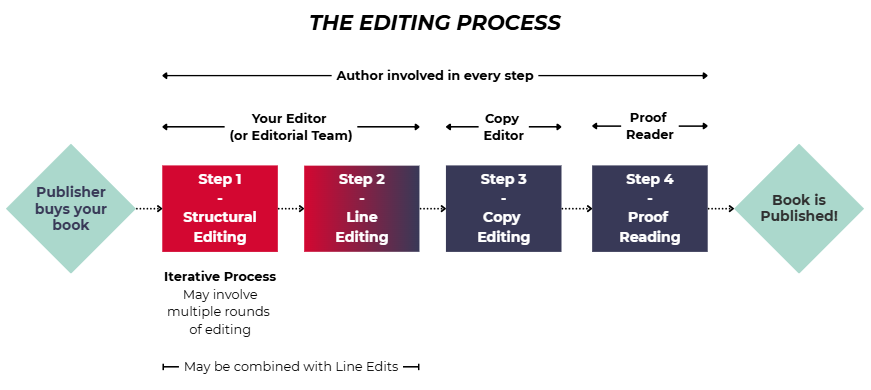
Structural Editing often takes several rounds for both the author and editor to be happy with the finished result. This is completely normal. It can also sometimes be combined with Line Editing, which focusses on polishing the prose at paragraph and sentence level, with the aim of making the book more readable.
The editing process is often daunting. It certainly was for me, even though I’d already received a lot of feedback from other readers, my writing mentor and my agent. But I was determined to make the most of this process, so here’s part one of my experience of editing with my publisher…
Round One: Structural Edits
I received my Structural Edits in July 2025. I’ll be honest, I wasn’t having a good week. It had been my grandmother’s funeral the day before and I wasn’t in the best of moods. However, I have a really lovely editor (in fact, the whole editorial, marketing and publicity team is fab) so despite life doing it’s best to derail me, I was genuinely looking forward to reading my edits.
The email notes were exactly what I expected and I was delighted to read them. The marked-up document was just the same; the vast majority of suggested changes were reasonable and achievable, reflecting (in my opinion) a minimum of metaphorical red pen, even if many of them related to my characters drinking or making tea on an incredibly frequent basis.

Of course, there were also a few changes that I didn’t agree with, including reformatting a chapter that I felt worked better as it was (more on this later). The important thing with feedback is to take time, because your initial emotional and reactive response to any criticism tends not to bear out after a couple of days, when the initial shock passes and you’re able to view those suggestions through a much more logical lens.
I asked for a call to talk through the changes, which happened at the end of the week. This allowed us to have a very productive conversation about a couple of points, and also establish that there were a few edits that didn’t need an immediate change, because dealing with others might solve the problem.
Shortly afterwards, and armed with a full spreadsheet of notes, I began my edits.
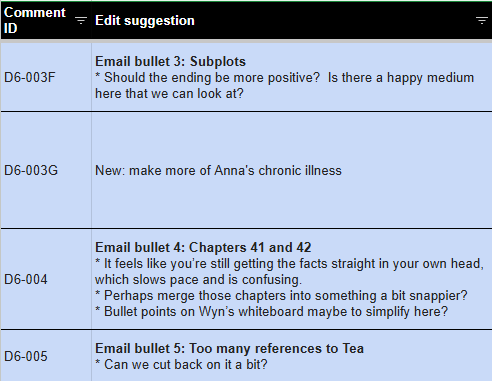
In total, there were 136 suggested changes, of which 122 were accepted and completed. I worked through the manuscript in four stages:
Tiny or small changes — single line changes that typically took less than 30 minutes to fix, e.g. typos, easy deletions or minor clarifications.
Medium changes — things that affected single paragraphs (or at most a whole chapter) and took an hour or two to fix.
Then I pivoted to working through the novel chronologically, dealing with:
Large or huge changes — things affecting multiple chapters or the entire book, and took several hours or multiple sessions to fix.
Finally, I completed a full readthrough of the novel, from start to finish to make sure I hadn’t created any new errors or broken continuity.
Only when I was convinced that I’d addressed all the changes — and not made the book worse! — did I return the manuscript to my editor with notes of what I thought had definitely improved, what I wasn’t sure about, and a few questions of other things we could change.
The whole process took nine weeks, returning the manuscript in September.
Note: I’ve since heard other authors have been advised to follow an 80/20 rule with edits; i.e. accept and change 80% of them. I’ve never been told this, and tend to accept a higher percentage, but it’s an interesting rule of thumb.
Round Two: Combined Structural and Line Edit
I received my second round of edits in November. Once again, I was in a bit of a strange mood. Honestly, it doesn’t happen that often, it was just bad timing, because it had recently been the anniversary of my Mum’s passing.
Thankfully, my editor was really pleased with the changes I’d made. We considered going straight to Copy Editing, before erring on the side of caution and opting for a second round of combined Line and Structural Edits. I wasn’t at all fazed by this. I’d expected multiple rounds, and since there were a few things I still wasn’t sure about, I leapt into it wholeheartedly.
This time, there were significantly fewer suggested changes, with only one that I thought would take a decent chunk of time. It was the troublesome chapter again — the one I rejected the formatting changes on before — which just goes to show that sometimes you know the chapter is wrong, but you don’t immediately know how to make it right! We decided to change the structure of it so that it was more active, the characters would have more agency, and the pace would improve as a result.
In total, there were 34 suggested changes, of which 27 were accepted. I worked through the manuscript in exactly the same way as the previous round and, with considerably less to do, finished in just four weeks; returning the manuscript in December.
Round Three: Signing off the manuscript
Once the structural and line edits have been done, the final step is to sign off the manuscript. This is usually a contractual milestone and marks the point where no further editorial work needs to take place, apart from copy editing and proof reading.
We signed off Anna 1 at the start of February, which was a massive weight off my mind. As an experienced project manager, my stomach churns whenever a deadline approaches; especially when it’s one I can’t control. And as an almost-recovering perfectionist, I still worry that the book won’t be good enough. But now it’s done and another part of my debut journey is complete.
This brings us up to date in my path to publication.
All in all, I found Structural and Line Editing to be a fascinating process; one that has not only improved Anna 1, but has also given me a lot to think about in how I write future books. So for now, I’m second drafting Anna 2, and will update you again on my editing progress later in the year.
In the meantime, here’s what’s coming up on Arsenic & Cold Case:
1st Mar: Writing Anna 2 with early editorial feedback
15th Mar: The Joy of Book Clubs
Thanks for reading. See you next time!